File ITR-2 Online
ITR-2 FAQs
1. Who is eligible to file ITR-2 for AY 2026-27?
ITR-2 form is applicable to individuals (Resident or Non-Resident) and Hindu Undivided Families (HUFs) deriving income other than income chargeable under the head “Profits and Gains of Business or Profession.”
It can be filed where the assessee has income from one or more of the following sources:
- Income under the head “Salaries” or “Pension”.
- Income from house property, including income from more than two house property.
- Income chargeable under the head “Capital Gains”, whether short-term or long-term,
- Income from other sources, including winnings from lotteries, racehorses, betting, gambling etc.
- Agricultural income exceeding ₹5,000.
ITR 2 Form can be filed irrespective of the quantum of total income, including cases where total income exceeds ₹50 lakhs.
Further, an individual who is:
- a director in a company; or
- a holder of unlisted equity shares at any time during the relevant previous year, is required to furnish the return in Form ITR-2.
2. Who is not eligible to file ITR-2 for AY 2026-27?
ITR-2 cannot be filed by any individual or HUF, whose total income for the year includes income from profit and gains from business or profession, and also who has income in the nature of:
- interest
- salary
- bonus
- commission or remuneration, by whatever name called, due, or received from the firm taxable under the head “Profits and Gains of Business or Profession.
3. What are the tax rates and rebate as per section 87A applicable for new tax regime for AY 2026-27?
Income Tax Slab rate under new tax regime is as below:
Upto Rs. 4,00,000- Nil
From Rs. 4,00,001 to Rs. 8,00,000 -5 per cent.
From Rs. 8,00,001 to Rs. 12,00,000- 10 per cent.
From Rs. 12,00,001 to Rs. 16,00,000- 15 per cent.
From Rs. 16,00,001 to Rs. 20,00,000- 20 per cent.
From Rs. 20,00,001 to Rs. 24,00,000- 25 per cent.
Above Rs. 24,00,000- 30 per cent.
Rebate u/s 87A in new regime is increased from 25000 to 60000 as applicable allowed upto 12 Lakhs of total income from A Y 2026-27 onwards.
4. Which documents are required to file ITR-2?
Below documents are required for filing ITR 2:
- If you have salary income, you need Form 16 issued by your employer.
- If you have earned interest on fixed deposits or saving bank account and TDS has been deducted on the same, you need TDS certificates i.e., Form 16A issued by deductors.
- You will need Form 26AS and AIS to verify TDS on salary as well as TDS other than salary. Form 26AS and AIS could be downloaded from the e-Filing portal.
- If you are living in rented premises, you need rent paid receipts for calculation of HRA (in case you have not submitted the same to your employer).
- If you have any capital gains transactions in shares, you will need a summary or profit/loss statement of capital gain transactions of shares or securities during a year, if any, for computation of capital gain.
- You will need your bank passbook, Fixed Deposit Receipts (FDRs) to calculate amount of interest income.
- If you have received rent from your rented house property, then you will need your tenant / local tax payment / interest on borrowed capital details (if any) to calculate income from house property.
- In case you want to claim any loss incurred during the current year, then you will need the relevant documents exhibiting the loss.
- In case you wish to claim previous year’s loss, you will need a copy of previous year return or ack, disclosing the said loss.
- You will also need documents or proofs for claiming tax saving deductions u/s 80C, 80D, 80G, 80GG such as life and health insurance receipts, donation receipts, rent receipts, receipts for tuition fees etc., if the same were not considered in your Form 16.
5. What precautions should I take to avoid issues while filing my ITR?
To avoid issues in filing your return and getting your refund, you must ensure you have done the following:
- Linked Aadhaar and PAN (recommended).
- Pre-validated your bank account where you want to receive your refund.
- Choose the correct ITR Form before filing it; else filed return will be treated as defective, and you will need to file a revised ITR using the correct Form.
- Filed the return within the specified timelines.
- Verify your return – you can opt for e-Verification (recommended option – e-Verify Now) as it is the easiest way to verify your ITR.
6. Can an HUF / Firm claim rebate u/s 87A?
No. Rebate u/s 87A is available only to an individual; hence, any person other than an individual cannot claim rebate u/s 87A.
7. I am a non-resident. Can I claim rebate u/s 87A?
No. Rebate u/s 87A is available only to an individual who is resident in India; hence, non-residents cannot claim rebate u/s 87A.
8. I own two houses. One is a farmhouse that I visit every week, and the other is my residence. Can both these residences be treated as self-occupied?
Up to AY 2019–20, you can claim only one property as self-occupied property and the other property will be deemed to be let-out.
From AY 2020–21 onwards, both the houses can be treated as self-occupied properties for residential purpose subject to fulfilment of specified conditions.
From the AY 2026-27, the specified conditions for treating two houses or part thereof as self-occupied property i.e. either if owner uses for his own residence or cannot occupy it due to reason of his business, profession or employment has been removed.
9. How should one compute income from a property that is self-occupied for part of the year and let out for part of the year?
In this case, for the purpose of computation of income chargeable to tax under the head Income from House Property, such a property will be treated as let-out throughout the year, and income will be computed accordingly.
However, while computing the taxable income in case of such a property, actual rent will be considered only for the let-out period.
10. What incomes are charged to tax under the head Capital Gains?
Any profit or gain arising from transfer of a capital asset during the year is charged to tax under the head Capital Gains.
11. What is the meaning of Capital Asset?
Capital Asset is defined u/ss 2(14) of the Income Tax Act, 1961 to include:
- Any kind of property held by an assessee, whether or not connected with business or profession of the assessee.
- Any securities held by a FII which has invested in such securities in accordance with the Regulations made under the SEBI Act, 1992 (subject to certain exclusions).
12. What is the meaning of the term Long-Term Capital Asset?
- Any capital asset including the land or building or both, held for a period of more than 24 months, immediately preceding the date of its transfer will be treated as Long-Term Capital Asset.
- However, in respect of securities listed in a recognized stock exchange in India (Debentures and Government Securities, Units of UTI and Zero-Coupon Bonds), units of equity-oriented mutual funds, the period of holding to be considered is 12 months instead of 36 months.
- In case of unlisted shares in a company also or a unit of a Mutual Fund specified under clause (23D) of section 10, transferred from (1st day of April, 2014 to 10th day of July, 2014), the period of holding to be considered is 12 months instead of 36 months.
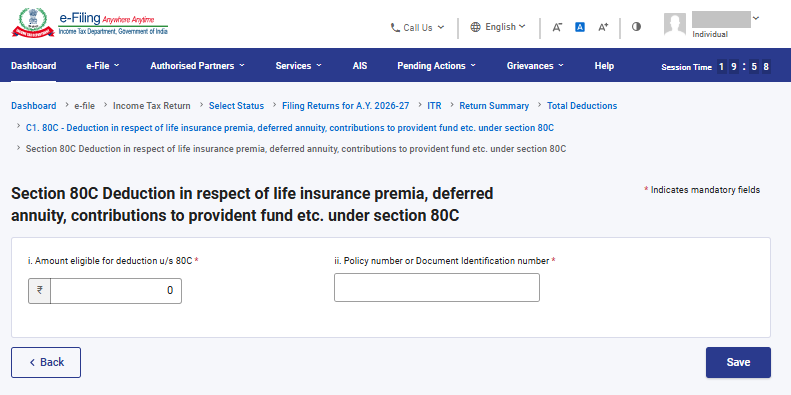
13. Do I need to give additional information if I am claiming deductions u/s 80C?
You must give additional information regarding deduction u/s 80C. If you want to claim a deduction u/s 80C, then you must enter the details below:
- Amount eligible for deduction
- Policy no. or Document identification No.
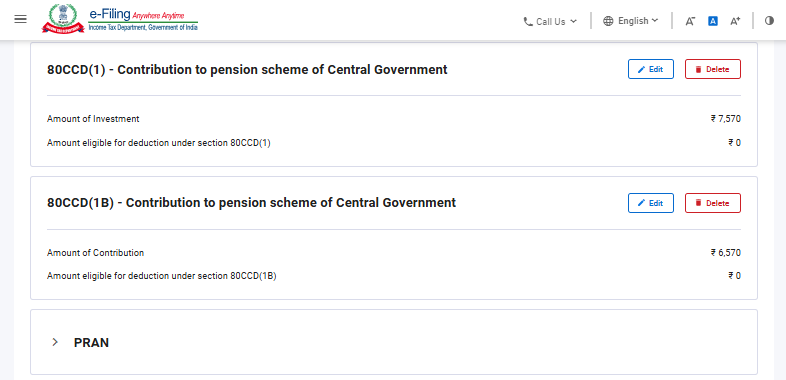
14. Do I need to give additional information if I am claiming deductions u/s 80 CCD (1) or 80CCD(1B)?
You must give additional information regarding deduction u/s 80CCD (1) or 80CCD(1B). If you want to claim these deductions, then you must enter the PRAN by clicking on PRAN tab. Please note that multiple PRAN details can also be added.
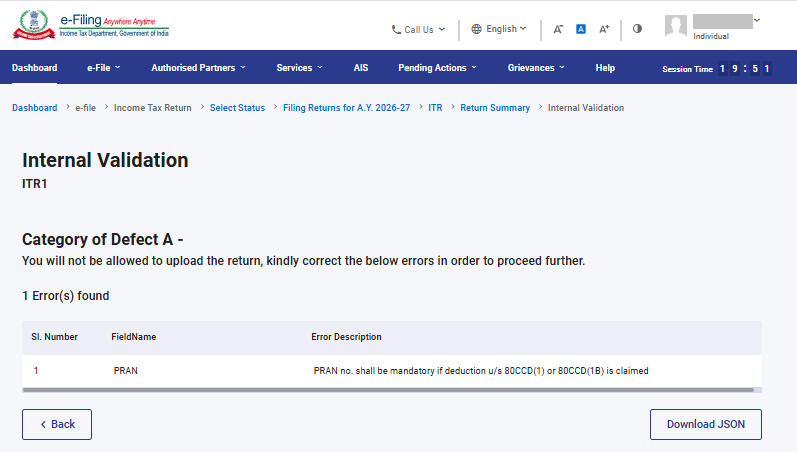
If you forgot to enter PRAN in PRAN tab you will see below validation error:
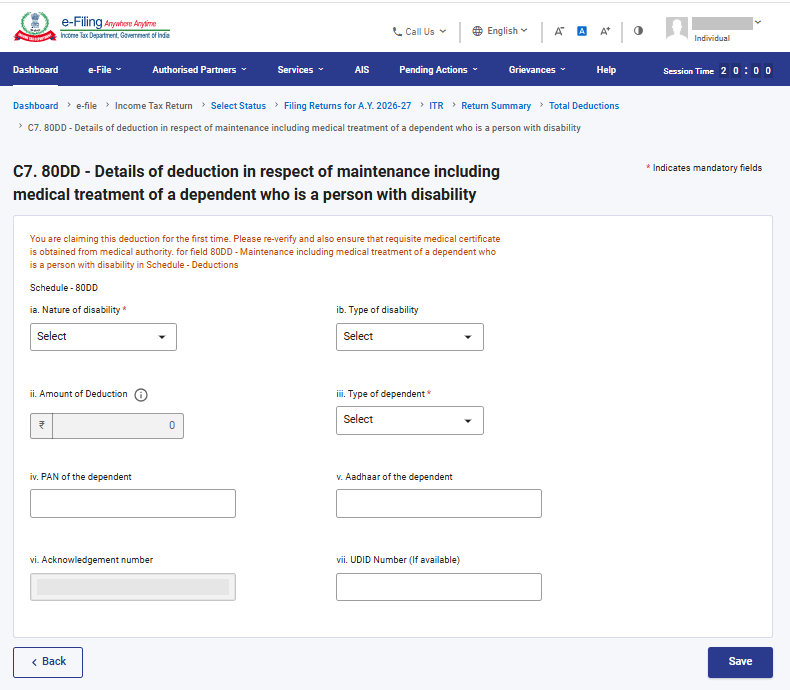
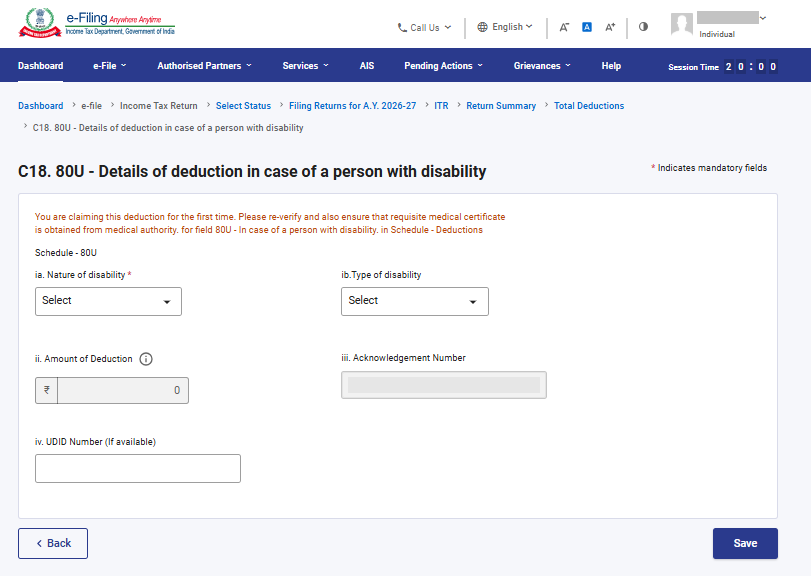
15. What additional information I must furnish in ITR 2 form if I am claiming deductions u/s 80 DD Or 80U?
You must give additional information regarding deduction u/s 80 DD or Section 80U. If you want to claim deduction u/s 80 DD or 80U, then you must enter the details below:
- Nature Of Disability
- Type of Disability
- Type of Dependent
- Amount of Deduction
- PAN of Dependent
- Aadhaar of Dependent
- Acknowledgement no. of Form 10 IA filed
Deductions u/s 80 DD:
Deductions u/s 80 U:
16. Do I need to give additional information if I am claiming deductions u/s 80 D?
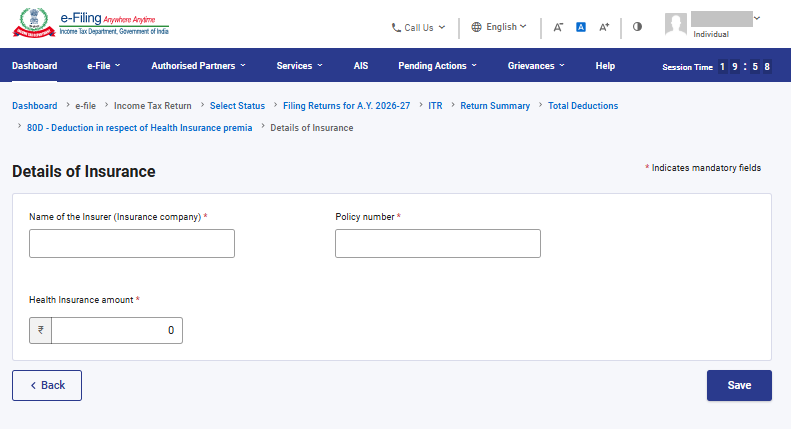
You must give additional information regarding deduction u/s 80 D. If you want to claim deduction u/s 80 D, then you must enter the details below:
- Name of the Insurer (Insurance Company)
- Policy Number
- Health Insurance amount
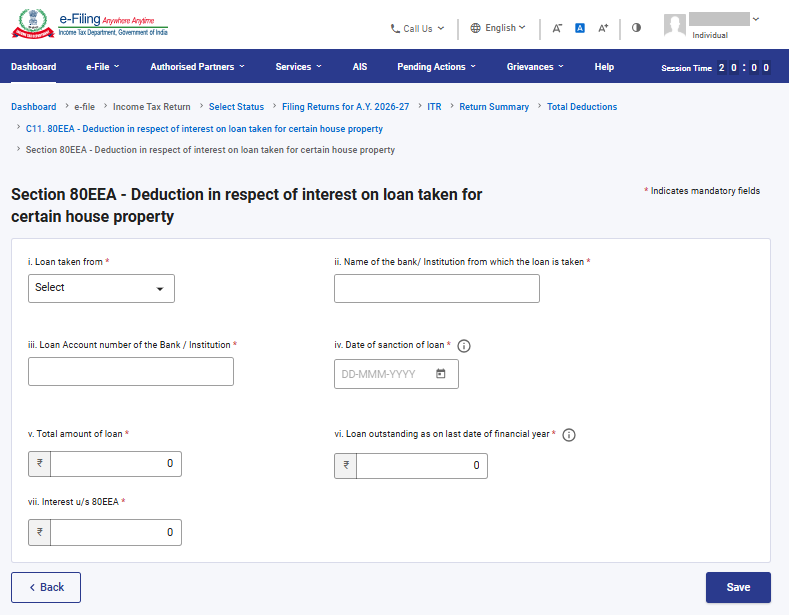
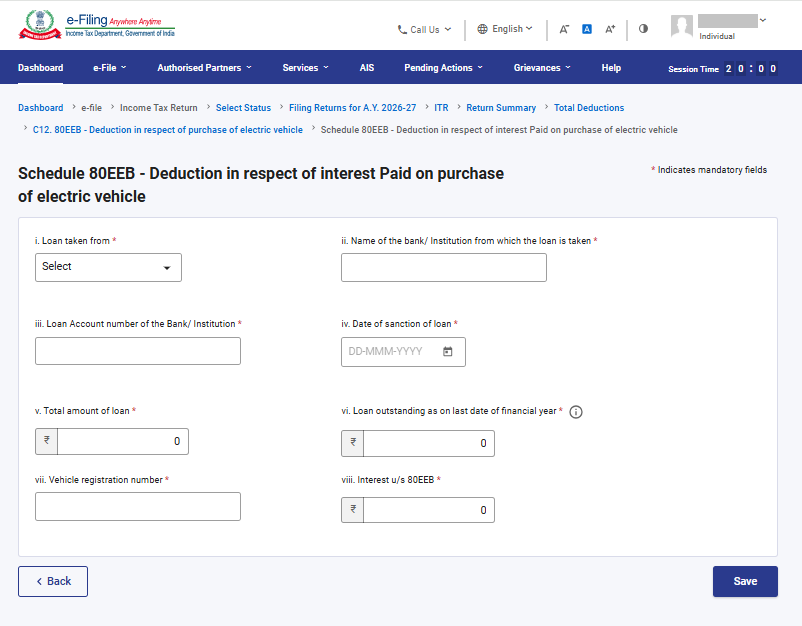
17. Do I need to give additional information if I am claiming deductions u/s 80 E, 80 EE, 80 EEA & 80 EEB?
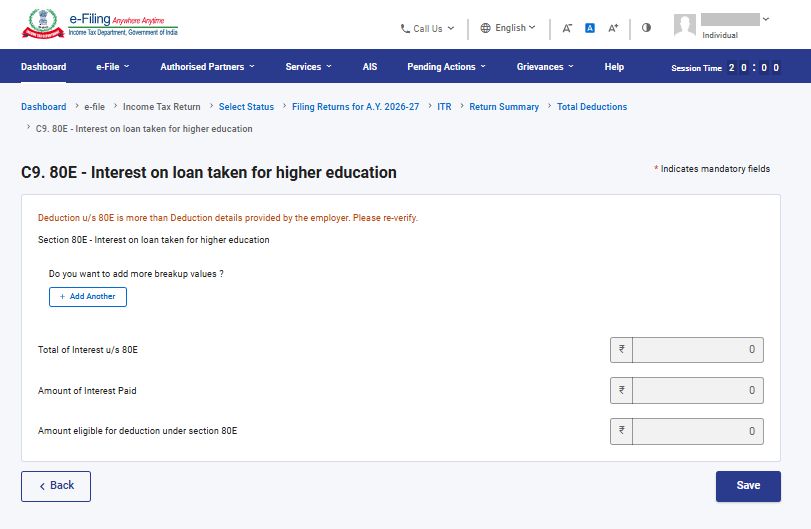
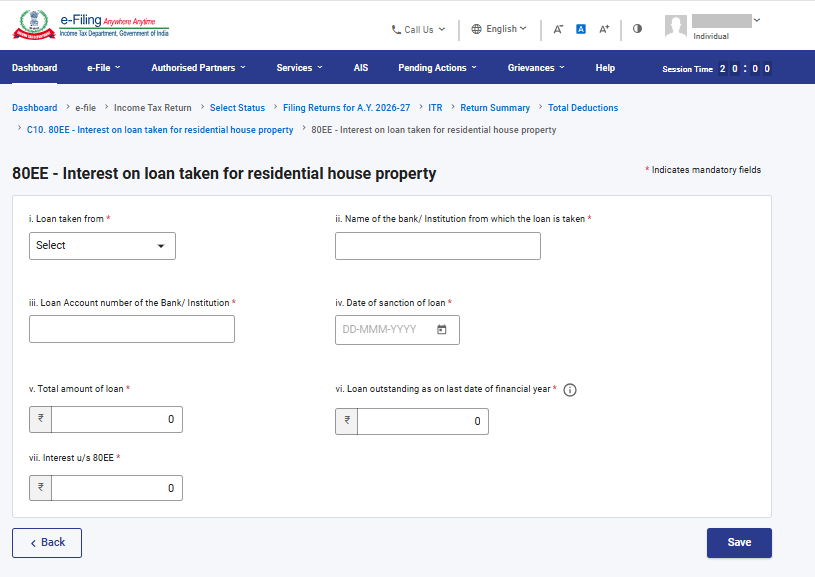
You must give additional information regarding deduction u/s 80 E, 80 EE ,80 EEA and 80 EEB. If you want to claim a deduction under these sections, then you must enter the details below:
- Loan taken from
- Name of the institution or bank
- Loan Account No.
- Date of sanction of loan
- Total Amount of loans
- Loan outstanding as on date
- Interest amount
Deductions u/s 80 E:
Deductions u/s 80 EE:
Deductions u/s 80 EEA:
Deductions u/s 80 EEB:
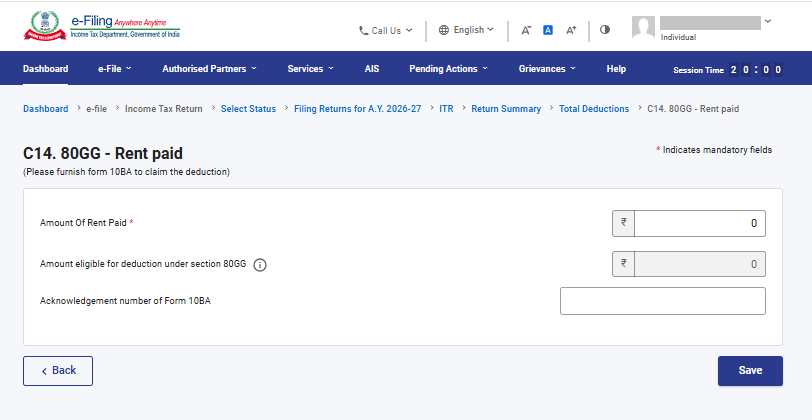
18. Do I need to file any form if I am claiming deduction u/s 80GG?
If you want to claim deduction u/s 80GG then you must mandatorily file from 10 BA before filing the return of Income and enter the details (acknowledgement no.) of Form 10 BA in Schedule 80 GG while filing the return of Income.
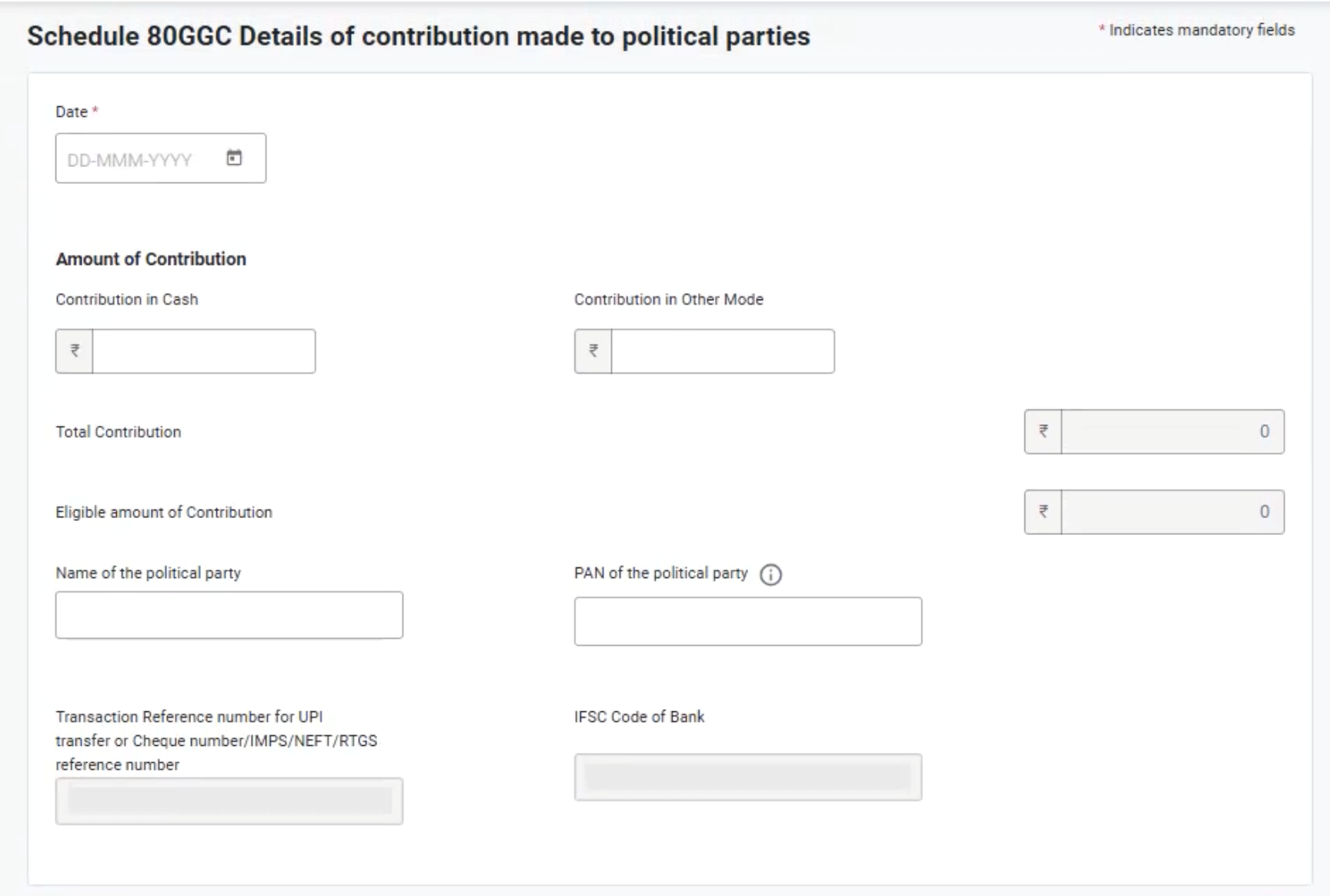
19. Do I need to give additional information if I am claiming deductions u/s 80GGC?
If you want to claim deduction u/s 8GGC then you must mandatorily report additional details such as Name and PAN of political party.
20. Do I need to give additional information if I am claiming deductions u/s 80CCC?
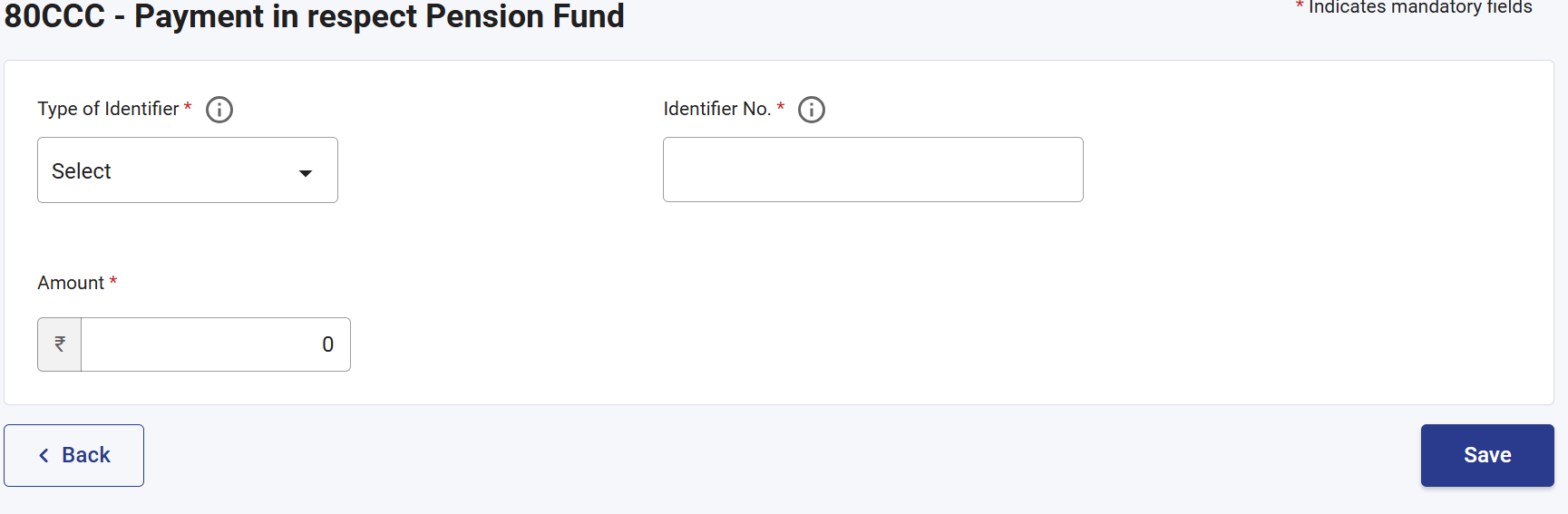
If you want to claim deduction u/s 8CCC then you must mandatorily provide below details like Type of Identifier such as PRAN or other than PRAN, Identifier No. and Amount details. Option to add multiple identifiers is also provided.
21. What are the changes in schedule personal information under contact details applicable for AY 2026-27?
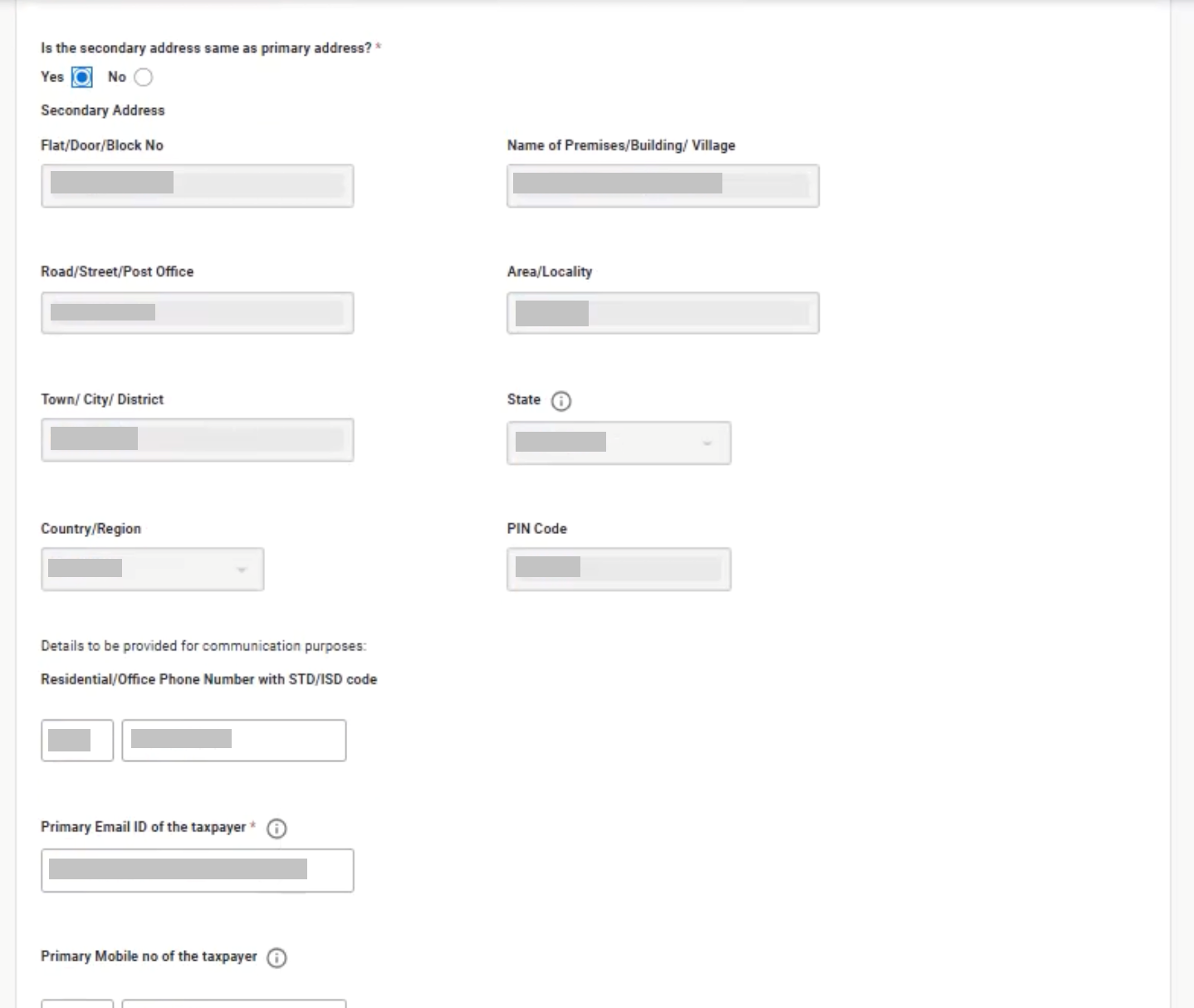
A new field for a secondary address has been introduced in Part A – General Information. Please note that user needs to edit the contact details and provide the mandatory question response as “Is the secondary address same as primary address”.
22. What is the fees structure levied u/s 234-I of the Income tax Act,1961?
234I is the additional fees payable on filing the revised return after 31st Dec of the Assessment Year, applicable from AY 2026-27 onwards. For AY 2026-27, it is applicable from 1st Jan 2027. The fees structure is given below.
- Rs. 1000 for Total Income up to Rs.5 Lakh
- Rs. 5000 for Total Income exceeding Rs.5 Lakh
23. Do I need to give any additional information if I am claiming deductions u/s 80G for AY 2026-27?
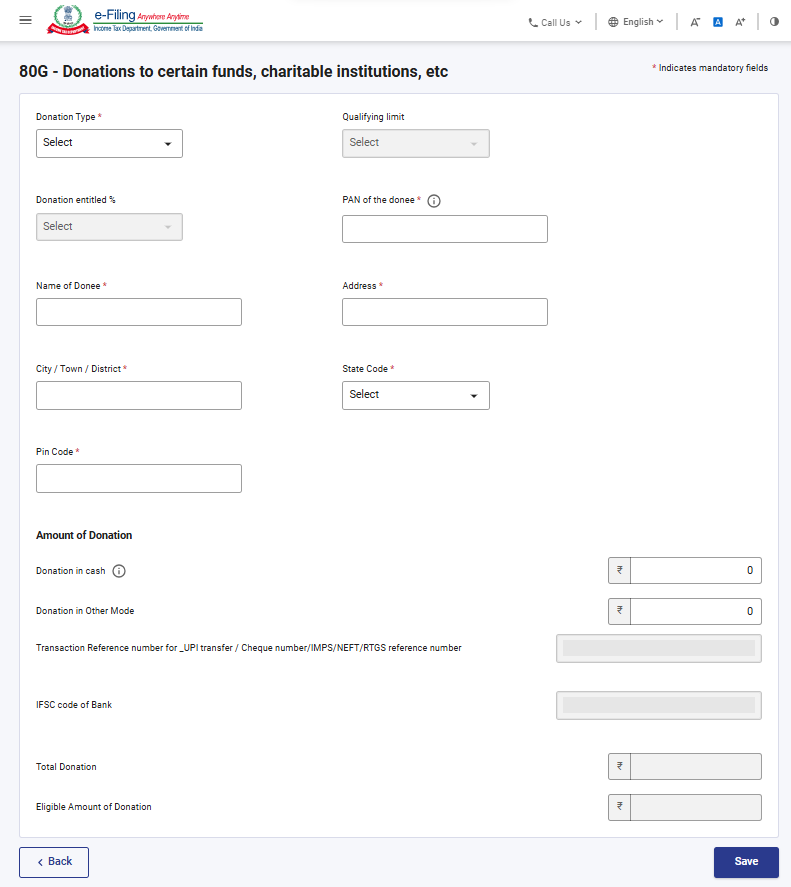
If you want to claim deduction u/s 80G then you must mandatorily provide additional details such as transaction reference number and IFS code of Bank.
24. Do I need to provide the bifurcation based on date of transfer of asset while reporting the capital gains income under schedule CG for AY 2026-27?
The requirement to report capital gains based on date of transfer as before and after 23rd July 2024 has been removed from AY 2026-27. Also please note that the Short term capital gains and Long term capital gains chargeable rate has also been modified as per the rates applicable for AY 2026-27.